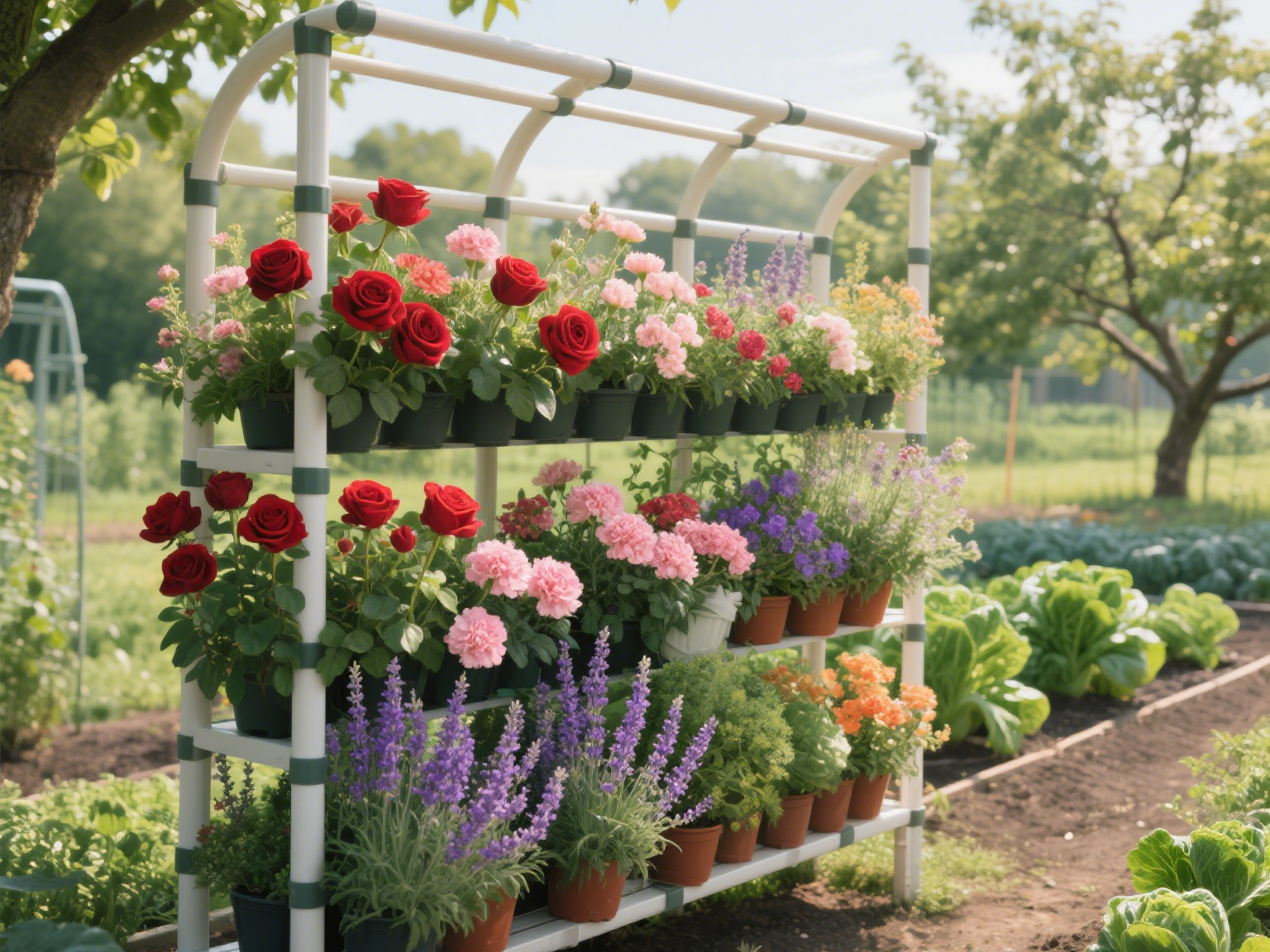
In a ordinary village on the Chengdu Plain, 58-year-old Lao Zhang and his wife tend to a 20-square-meter courtyard vegetable garden. Enclosed by red bricks, this small plot serves as both their “vegetable basket” and the spiritual anchor of their retirement life. However, the annual challenge of supporting climbing plants had long been a persistent headache—traditional bamboo racks collapsed every year, cucumber vines sprawled chaotically before fully growing, and tomato-laden branches strained the frames until they creaked. The turning point came when Lao Zhang’s son, recalling our company’s experience with PVC fencing and flower stands from past collaborations, suggested trying a height-adjustable PVC flower stand. This seemingly ordinary plastic rack has since revolutionized their garden.
Lao Zhang’s garden follows a classic four-season crop rotation: cucumbers and green beans in spring, tomatoes and loofahs in summer, peas in autumn, and short-stemmed greens like choy sum in winter. For a decade, he relied on bamboo strips and twine to build climbing frames. The thumb-thick bamboo poles struggled to bear the weight of summer fruits. In a 2022 summer storm, three rows of tomato racks collapsed entirely, scattering unripe fruits—a heartbreaking sight for his wife. Bamboo’s vulnerability to wind and rain meant yearly labor of cutting, splitting, and binding at the start of each planting season, a 3-5 day task that grew increasingly arduous with age. After harvest, discarded bamboo racks were burned as firewood, wasting resources and harming the environment. “I wish there were a rack that could last more than a year,” Lao Zhang often sighed.
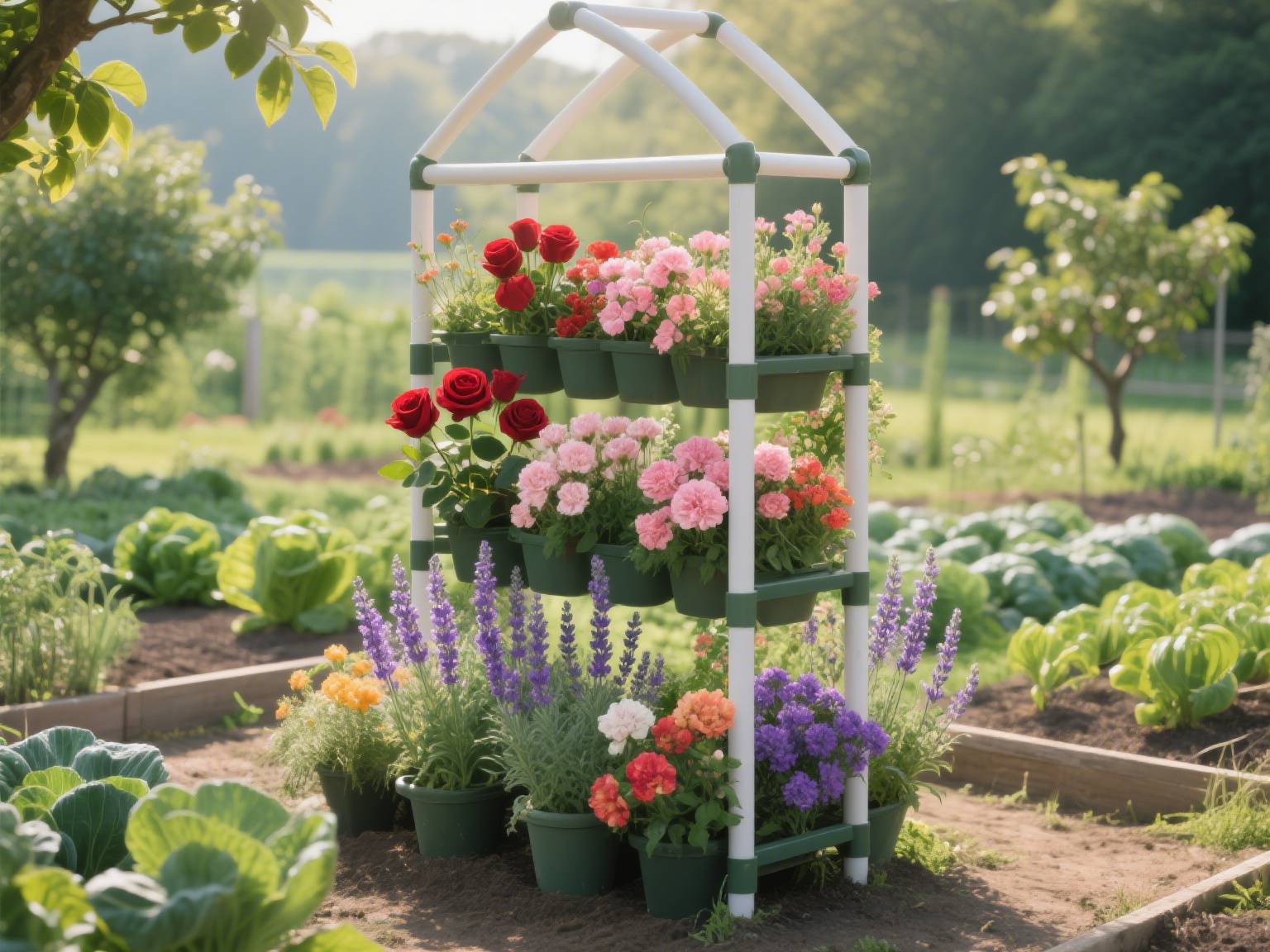
In early 2023, inspired by his son’s recommendation, Lao Zhang purchased a thickened PVC flower stand from our shop. This unassuming rack brought a radical shift in garden management:
Robust Structural Design
The 5cm-diameter cylindrical columns, crafted with a three-layer composite process, feature a hollow interior but 3mm-thick walls, each capable of supporting 80kg. Lao Zhang buried the columns 30cm deep in the ground, securing them with concrete—even typhoons failed to budge the structure. The crossbars, connected to the columns via snap-fit joints, can be adjusted between 20-50cm intervals. In spring, he sets wider spacing (50cm) for seedling ventilation; in summer, he narrows it to 20cm to support vigorous vines. “This rack grows with the plants,” Lao Zhang jokes.
The built-in 20cm-wide PVC planting troughs at the base allow direct sowing or transplanting. In spring 2023, he planted lettuce beneath the cucumber vines—by the time the cucumbers climbed the rack, the lettuce had matured, their leaves shaded and protected from sunburn by the vines, resulting in tender, healthy greens.
Superior Material Durability
Unlike bamboo racks that rot within a year in moist soil, the PVC stand resists water and pests. Even the buried portions remained intact after three years of use. Lao Zhang calculated the savings: “Bamboo racks cost about ¥200 annually, while this PVC stand costs ¥800 but will last at least 5 years—that’s ¥120 saved each year.”
Lightweight and easy to assemble, each column weighs just 1.2kg, and crossbars 0.5kg, allowing Lao Zhang to install and disassemble the rack alone. After harvest, he simply unfastens the clips, storing the components under the eaves and freeing up the garden for winter tilling.
Versatile Functionality
In winter, with no crops growing, Lao Zhang adjusts the crossbars to their widest setting, transforming the rack into a drying rack for corn, chili peppers, and cured meats—sturdy enough to hold even a quilt. “It’s more durable than store-bought drying racks, and nothing blows away in the wind.”
In spring, before seedlings grow tall, his wife plants petunias in the troughs. Their purple blossoms climb the rack, turning the once-dull garden into a living flower wall. Neighbors passing by now ask, “What’s this new-style rack? It’s prettier than those in city parks!”
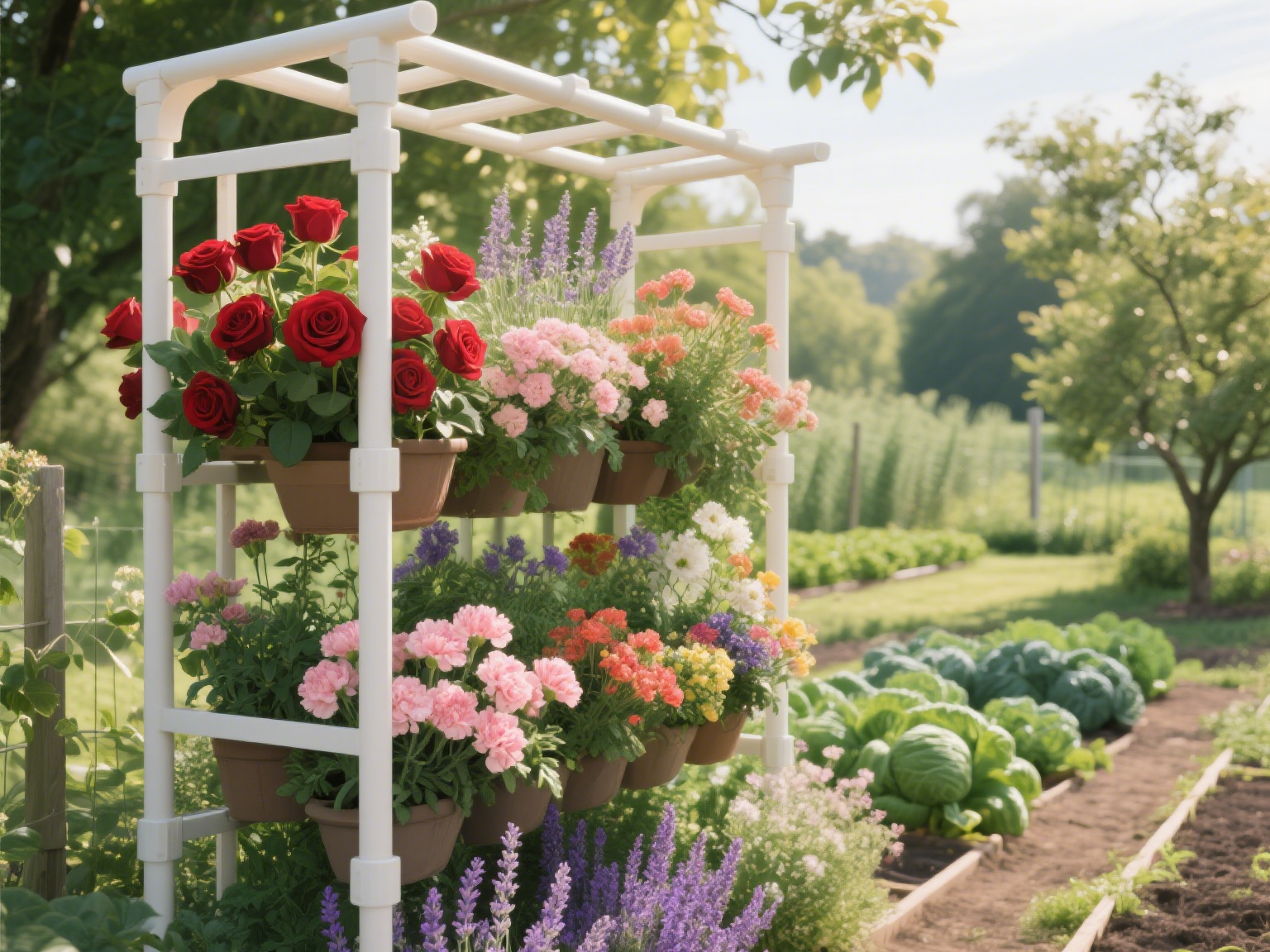
Today, Lao Zhang’s garden has become a village landmark. On weekends, his grandson plays hide-and-seek among the cucumber vines, while his wife picks vegetables and snaps photos to share in family chat groups. Lao Zhang takes pride in being a neighborhood “technical advisor”—five households have since switched to PVC racks, all inspired by his experience and now consulting our company. “I used to think farming was just hard labor,” Lao Zhang says, adjusting a crossbar, “but the right tools make all the difference.” The PVC stand has taught him that rural life need not be defined by toil; with modern materials, it can be both effortless and elegant.
By replacing bamboo racks, Lao Zhang reduces annual waste by approximately 50kg, equivalent to sparing 20 bamboo trees from being cut down. “Plastic isn’t a perfect substitute, but at least we’re not cutting down trees every year.” He also notes that discarded PVC components can be recycled, with recycling rates steadily increasing, as his son has shared.
Lao Zhang’s PVC flower stand symbolizes more than a gardening tool; it reflects the transformation of rural life in contemporary China. As retired farmers embrace e-commerce, study material properties, and share innovative practices, traditional farmsteads are merging with modern civilization. As Lao Zhang wrote in his garden journal: “Bamboo racks held up bygone days, while PVC stands prop up today’s life. With a little creativity, even muddy fields can bloom with ‘technological wonder.’”
In an era of rapid urbanization, this pastoral wisdom holds special significance—it preserves the earthy charm of “rising at dawn to tend the fields” while infusing modern agricultural technology, allowing every inch of land to thrive in both practicality and beauty.